
Shaheen Proxy
High-Performance Proxy Aggregation & Routing Middleware



Shaheen Proxy is a specialized middleware server developed in Rust. It functions as a unified gateway that aggregates disparate upstream proxy providers (SOCKS5, HTTP) into a single, standardized interface. By abstracting the complexity of vendor-specific implementations, it allows client applications to interact with a distributed pool of resources through a coherent API, handling session management, protocol translation, and security enforcement transparently.
Technical Overview & Problem Statement
In automated data retrieval infrastructure, managing proxy resources is a significant friction point. Different providers impose unique authentication schemas, rate-limiting headers, and error formats.
Core Capabilities:
- Unified Interface: Abstraction of vendor-specific protocols into a single standard. Clients interface with Shaheen, which manages the translation logic for upstream providers.
- Traffic Sanitization (Whitelabeling): The proxy acts as a security firewall for response metadata. It intercepts upstream error messages (e.g., vendor-specific bandwidth limits or 403s) and translates them into generic HTTP status codes, preventing information leakage about the underlying infrastructure.
- Stateless Routing: Complex routing logic—such as distinct geolocation targets or session stickiness—is encoded directly in the credentials (
user_country-US_session-1a), keeping the API stateless and scalable.
Dynamic Template Engine
One of the system’s most innovative features is its Data-Driven Adapter Layer. Instead of hardcoding logic for every new proxy provider, Shaheen utilizes a flexible JSON-based template system. This allows the routing engine to dynamically construct authentication strings and connection URLs based on the target provider’s requirements.
How it works: The system maps generic parameters (User, Country, Session) to vendor-specific formats using configuration templates.
Example Configuration (Dummy Data):
"templates": {
  "CloudRotator": {
    "url_format": "http://customer-{user}-cc-{country}-sess-{session}:{password}@{host}:{port}",
    "default_params": { "country": "us" }
  },
  "StaticBackbone": {
    "url_format": "socks5://{user}:{password}_country_{country}@{host}:{port}",
    "requires_whitelist": true
  }
}
When a request arrives, the ProxyManager identifies the optimal provider and hydrates the corresponding template. This architecture allows for the addition of new upstream vendors via configuration updates alone, requiring zero code changes or recompilation.
Architecture & Implementation
The system is built on the Tokio asynchronous runtime to ensure non-blocking I/O operations, critical for high-throughput middleware.
Stack
- Core Runtime: Tokio (Multi-threaded work stealing scheduler)
- Protocol Layer: Hyper (HTTP/1 & HTTP/2 implementation)
- Upstream Client: Reqwest (customized for high-concurrency pooling)
Request Flow

The Interceptor Pattern:
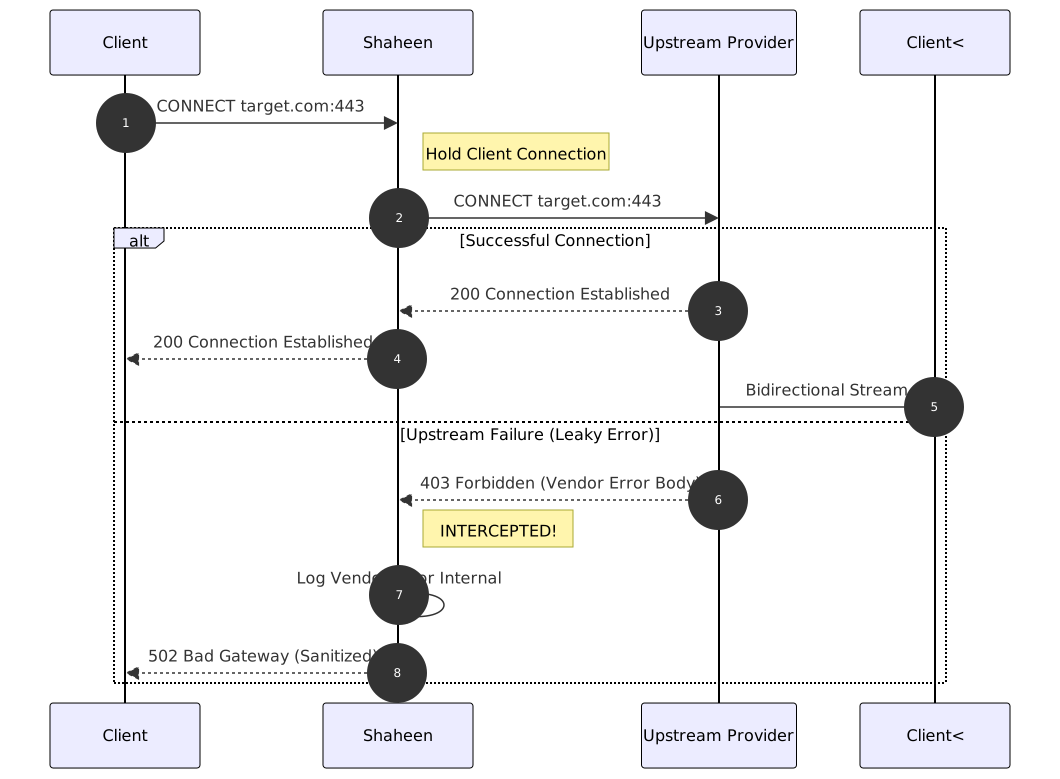
A critical component for stability is the Connection Pre-flight & Interception mechanism. Standard tunneling behaviors can cause client crashes if an upstream proxy returns an HTML error body during a handshake (e.g., a “407 Proxy Auth Required” page instead of a TCP stream).
Shaheen implements a “Look-Ahead” buffer during the connection phase:
- Establish Upstream: The server connects to the provider but holds the client connection.
- Analyze Handshake: It inspects the first packet returned by the upstream.
- Sanitize: If the upstream returns a provider-specific error (leaking vendor info), Shaheen intercepts it, logs the detailed telemetry internally, and returns a generic
502 Bad Gatewayor503 Service Unavailableto the client. - Confirm: Only upon a successful
200 Connectedresponse is the byte stream bridged to the client.
Scalability Challenges & Future Architecture
While the current implementation performs robustly on a single node (handling hundreds of concurrent threads), distinct challenges emerge under extreme load (1000+ RPS).
Current Bottlenecks
- Session Locking: The internal session storage uses standard Mutex locks (
std::sync::Mutex). Under high concurrency, lock contention for reading/writing session states becomes a performance bottleneck. - Ephemeral Port Exhaustion: Basic connection pooling can struggle with rapid recycling of outgoing connections to hundreds of different upstream IPs.
Distributed Roadmap:
 To move from a single-node utility to an enterprise-grade cluster, the architecture is evolving towards a distributed model:
- Horizontal Scaling: Deploying multiple stateless Shaheen nodes behind a Layer 4 Load Balancer (e.g., HAProxy or NGINX).
- Distributed State Management: Refactoring the internal
HashMapsession storage to use an external, low-latency store like Redis. This will allow session stickiness to persist across different nodes in the cluster. - Circuit Breaking: Implementing robust failure detection that temporarily removes underperforming upstream nodes from the rotation pool across the entire cluster.
Status
The project is functional and in active development.
-
Core Status: Stable Alpha.
-
Protocol Support: HTTP CONNECT, SOCKS5.
-
Security: Active traffic masking and error sanitization.
Active Engineering Tasks
- Refactor Session Management: migrating from in-memory Mutex maps to lock-free concurrent data structures (e.g.,
DashMap) or external Redis storage. - Load Balancing Strategy: Designing the deployment architecture for multi-node orchestration.
- Observability: Integrating standard metrics (Prometheus) to visualize lock contention and upstream latency distribution.