What is a BST?
Definition
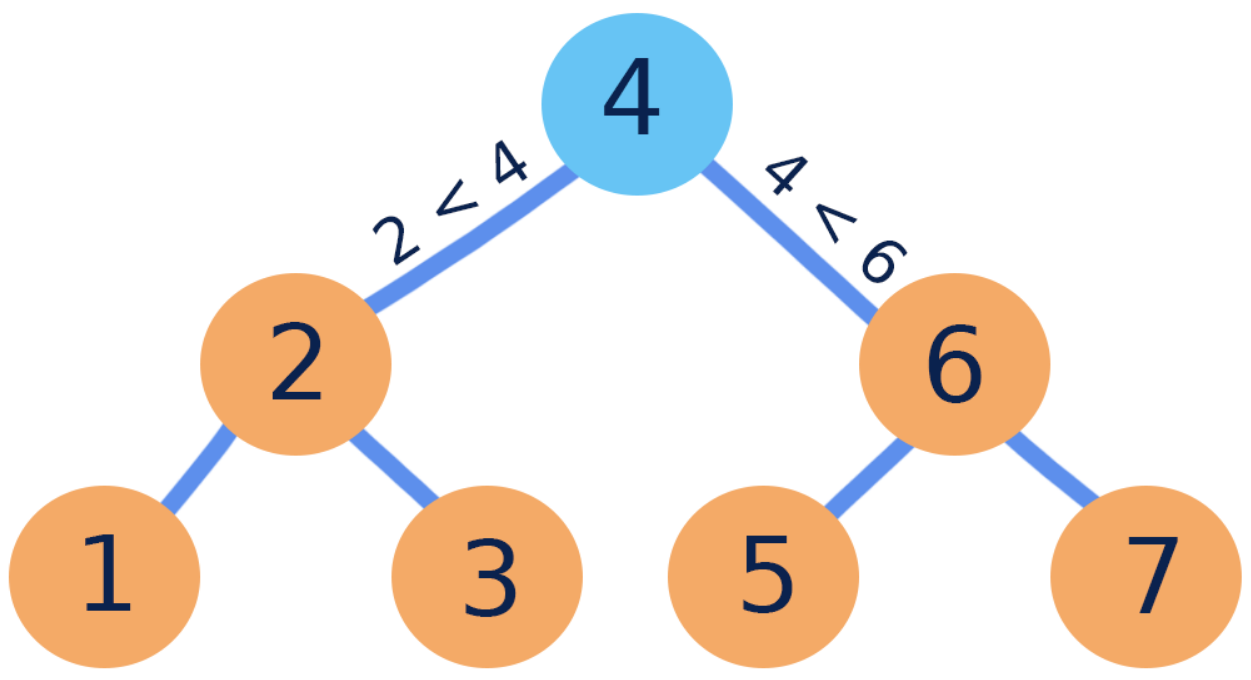
A Binary Search Tree (BST) is a hierarchical data structure in which each node has at most two children. The tree is organized such that:
- Nodes in the left subtree contain values less than the parent node’s value.
- Nodes in the right subtree contain values greater than the parent node’s value. This arrangement makes BSTs incredibly efficient for operations like searching, insertion, and deletion.
Real-World Analogy
Imagine a dictionary where words are stored in alphabetical order. This allows you to quickly search for any word by leveraging the order to skip over large portions of irrelevant data. A Binary Search Tree (BST) follows a similar concept, where elements are arranged in a manner that allows efficient searching, insertion, and deletion.
Structure
A BST is a binary tree in which each node has at most two children, satisfying the following properties:
- The left subtree of a node contains only nodes with values less than the node’s value.
- The right subtree of a node contains only nodes with values greater than the node’s value.
- Both the left and right subtrees must themselves be BSTs.
Properties
Key Characteristics:
- Sorted Order: In-order traversal of a BST produces elements in ascending order.
- Efficiency: Searching, insertion, and deletion have a time complexity of O(h), where h is the height of the tree.
- Dynamic Growth: BSTs dynamically adjust their size as elements are inserted or deleted.
Searching
Algorithm
- Start from the root node.
- Compare the target value with the current node’s value:
- If equal, return the node.
- If less, move to the left child.
- If greater, move to the right child.
- Repeat until the target is found or the subtree is empty.
Illustration
For a tree with root 7 and target 9:
          7
           \
            12
            /
           9
- Start at
7.9 > 7, move to the right. - At
12,9 < 12, move to the left. - At
9, target is found.
Code Snapshot
BST_NODE *bst_find(int target, BST_NODE *head_node)
{
    if (head_node == NULL) return NULL;
    if (head_node->value < target)
        return bst_find(target, head_node->right);
    if (head_node->value > target)
        return bst_find(target, head_node->left);
    return head_node;
}
Insertion
Algorithm
- Start at the root.
- Compare the value to be inserted with the current node’s value:
- If less, move to the left child.
- If greater, move to the right child.
- If the correct position is found (NULL child), insert the new node.
Illustration
Inserting 10 into this tree:
          7
        /   \
       5     12
            /
           9
- Start at
7.10 > 7, move to the right. - At
12,10 < 12, move to the left. - At
9,10 > 9, insert as the right child of9:
          7
        /   \
       5     12
            /
           9
             \
             10
Code Snapshot
bool bst_insert_node(BST_NODE **node_ptr, int value)
{
    if (*(node_ptr) == NULL)
    {
        *node_ptr = bst_create_tree(value);
        return true;
    }
    if (value > (*node_ptr)->value)
        return bst_insert_node(&(*node_ptr)->right, value);
    if (value < (*node_ptr)->value)
        return bst_insert_node(&(*(node_ptr))->left, value);
    return true;
}
Deletion
Algorithm
- Locate the node to delete.
- Handle three cases:
- No children: Remove the node directly.
- One child: Replace the node with its child.
- Two children: Replace the node with its in-order predecessor or successor.
Illustration
Deleting 12 from this tree:
          7
        /   \
       5     12
            /  \
           9    15
- Find
12. It has two children. - Replace
12with its in-order predecessor (9):
          7
        /   \
       5      9
               \
                15
Code Snapshot
BST_NODE *bst_delete_node(BST_NODE **root, int target)
{
    if (*root == NULL) return *root;
    if ((*root)->value < target)
        return bst_delete_node(&(*root)->right, target);
    else if ((*root)->value > target)
        return bst_delete_node(&(*root)->left, target);
    else
    {
        if ((*root)->right == NULL && (*root)->left == NULL)
        {
            free(*root);
            *root = NULL;
        }
        else if ((*root)->left == NULL)
        {
            BST_NODE *tmp = *root;
            *root = (*root)->right;
            free(tmp);
        }
        else if ((*root)->right == NULL)
        {
            BST_NODE *tmp = *root;
            *root = (*root)->left;
            free(tmp);
        }
        else
        {
            BST_NODE *proc = NULL;
            BST_NODE *suc = NULL;
            bst_find_predecessor_successor(*root, target, &proc, &suc);
            (*root)->value = proc->value;
            bst_delete_node(&(*root)->left, proc->value);
        }
    }
    return *root;
}
Traversals
In-Order Traversal
- Visit the left subtree.
- Visit the current node.
- Visit the right subtree.
Illustration
For the tree:
          7
        /   \
       5     12
      / \    /
     3   6  9
The traversal sequence is: 3, 5, 6, 7, 9, 12.
Code Snapshot
void bst_in_order_traversal(BST_NODE *node, void (*callback)(BST_NODE *node))
{
    if (node == NULL) return;
    bst_in_order_traversal(node->left, callback);
    callback(node);
    bst_in_order_traversal(node->right, callback);
}
Level-Order Traversal
- Use a queue to track nodes at each level.
- Enqueue the root.
- While the queue is not empty:
- Dequeue a node.
- Process it.
- Enqueue its children (left, then right).
Illustration
For the same tree:
          7
        /   \
       5     12
      / \    /
     3   6  9
The traversal sequence is: 7, 5, 12, 3, 6, 9.
Code Snapshot
void bst_lvl_order_traverse_queue(BST_NODE *node, void (*callback)(BST_NODE *node))
{
    Queue *q = create_queue();
    enqueue(q, node);
    while (!queue_is_empty(q))
    {
        BST_NODE *current = (BST_NODE *)dequeue(q);
        callback(current);
        if (current->left != NULL) enqueue(q, current->left);
        if (current->right != NULL) enqueue(q, current->right);
    }
    free(q);
}
Examples with Code
Here’s an example tree built from a sequence of insertions:
          7
        /   \
       5     12
      / \    /  \
     3   6   9   15
    / \     / \    \
   1   4   8  10   17
Using the provided code, you can create and manipulate this tree:
BST_NODE *node = NULL;
node = bst_create_tree(7);
int values[] = {5, 12, 3, 6, 9, 15, 1, 4, 8, 10, 17};
for (int i = 0; i < sizeof(values)/sizeof(int); i++)
    bst_insert_node(&node, values[i]);
bst_print_tree(node);
Practical Use Cases
- Databases: Used in
indexingand searching. - Compilers: Abstract syntax trees for parsing.
- Networking: Efficient routing table lookups.